

Product Information
Introduction to Q Series Capacitors
1. Product Position and Usage
1.1 Development Directions of Wireless Connectivity in Automobiles
-Industrialization → Informatization → Internet Integration
-General Capacitors → RF Capacitors
1.2 Addressing Automotive Product Needs
EYANG has developed the Q series automotive-grade RF capacitors to meet the demands of intelligent and connected automotive applications. The Q series MLCC features lower ESR and higher Q values compared to general MLCCs, making it suitable for high-frequency and big data exchange in vehicular communication.
1.3 Features of Q Series MLCC Products:
-Factories comply with IATF16949
-Products meet AEC-Q200 standards
-Suitable for automotive safety applications
-Inner electrode material: Cu
-High Q, low ESR characteristics
-High-temperature applications: withstand temperatures up to 125°C or 150°C
-High precision applications: tolerances of ±0.05pF or ±1%
2. Product Application Scenarios
2.1 Autonomous Driving
Autonomous driving has driven the need for intelligent and connected systems, increasing the demand for communication data volume and speed. Besides perceiving the surroundings through its own cameras and radar, the vehicle needs to gather and process more information through connectivity.
2.2 Vehicle-to-Everything (V2X) Coordination
With information obtained via V2X functionality, vehicles can perform tasks such as lane change confirmation, pedestrian yielding, traffic light waiting, green wave speed selection, road speed control, and intelligent navigation route adjustments, ultimately forming a unified system for dynamic road network dispatching.
2.3 Smart Parking
Smart parking involves transmitting parking space information and pedestrian data to vehicles, enabling functions like entry route planning, pedestrian avoidance, and automatic parking.
3. Comparison of RF Capacitors and General Capacitors
3.1 Design Differences
RF capacitors and general capacitors are designed differently to cater to specific applications.
.png)
3.2 Material and Process Differences
.png)
3.3 Frequency Characteristics Comparison:
Comparative data illustrating the frequency characteristics between Q series and E series capacitors:
.png)
4. Product Information
4.1 Material Code Example

4.2 Product Range:
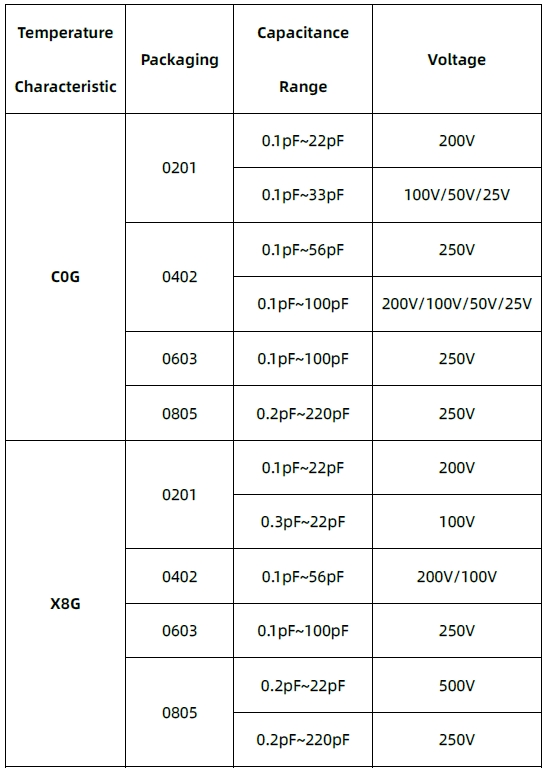
For more detailed information about this specification, please visit the EYANG Technology website at http://www.szeyang.com to download the relevant specification sheets or contact EYANG Technology FAE for further information.